Rigid inclusions
Overview
Control settlement and boost bearing capacity with a cost-effective ground improvement technique.
Rigid inclusions are an efficient and economical load-sharing solution. As a critical solution for ground improvement challenges, rigid inclusions provide an indispensable alternative to traditional deep foundation techniques in weak soils.
These high-modulus concrete columns are ideal for sites where a soft soil embankment naturally forms a load transfer platform, or in warehouses and pavements where the slab and pavement layer serves the same purpose.
RIX Ground Engineering has been at the forefront of rigid inclusion design and installation in Australia for decades. Using Finite Element Analysis, we deliver this cost-efficient ground improvement technique with almost zero spoil, noise and vibration.
Our process for the optimal foundation system
1. Site and soil analyses
Before installing a rigid inclusion system, we begin with a thorough site evaluation and detailed soil analysis. Our engineers assess subsurface conditions, determine soil strength, and identify the optimal foundation system depending on the project’s requirements.
This process ensures that the rigid inclusions installed are matched to the appropriate soil types and project loads, maximising stiffness and cost efficacy.
2. Precision design
The installation process of rigid inclusions is carefully planned during the design phase to ensure optimal performance and effective load transfer.
Our rigid inclusion systems begin with advanced 3D Finite Element Analysis (FEA). This engineering tool simulates how the soil and structure will interact under load, enabling us to model load transfer platforms and column layouts accurately.
Each design aims at increasing the bearing capacity of weak soils while preventing design choices that could induce excess settlements, ensuring the foundation remains stable and cost-effective. We also optimise the number, spacing, and depth of columns. The result is a design that meets performance requirements without unnecessary construction costs.
3. Strategic soil displacement
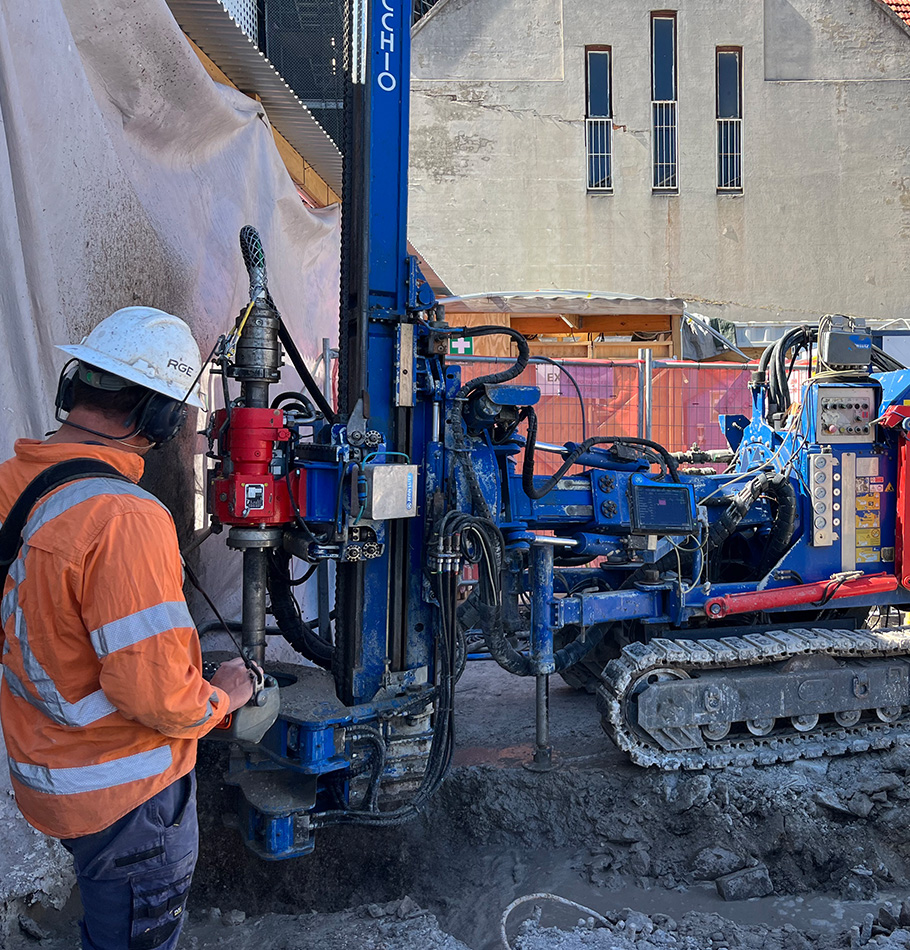
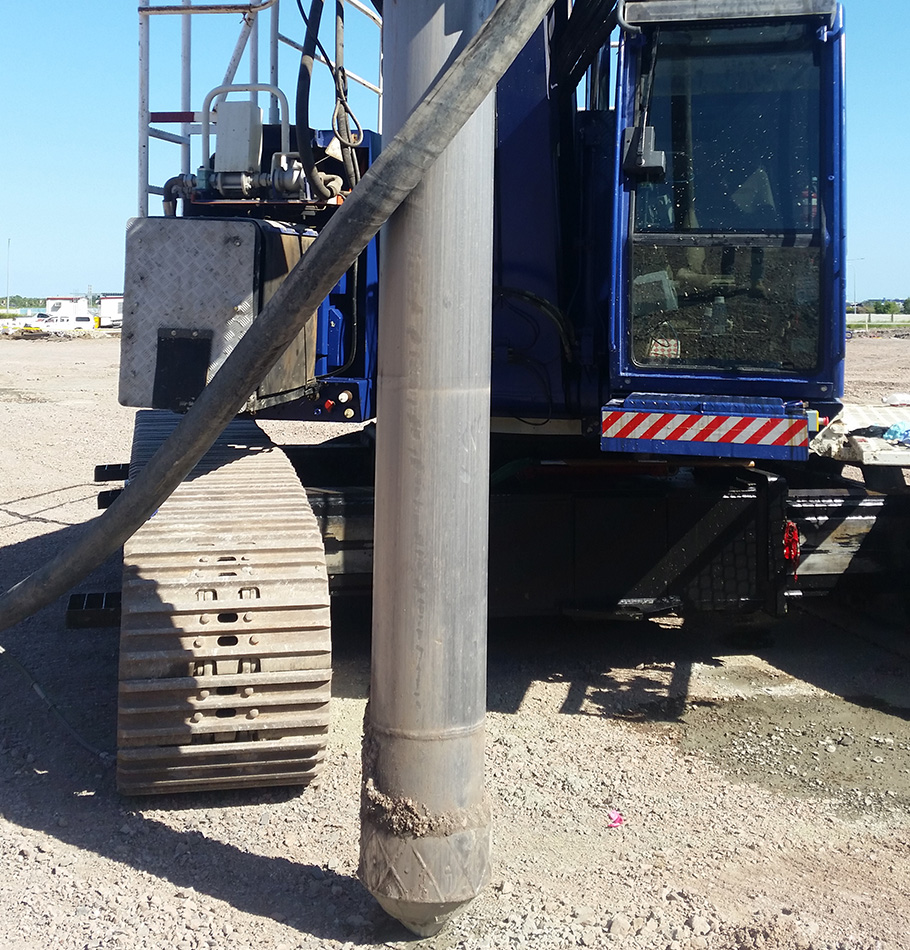
After preparing the working platform, the installation rig is accurately positioned, and real-time data recording begins. Using a displacement auger or vibrated tube, the tool penetrates the soil to the designed depth.
This process displaces soil and forces soil laterally, enhancing ground stability and minimising environmental disturbance.
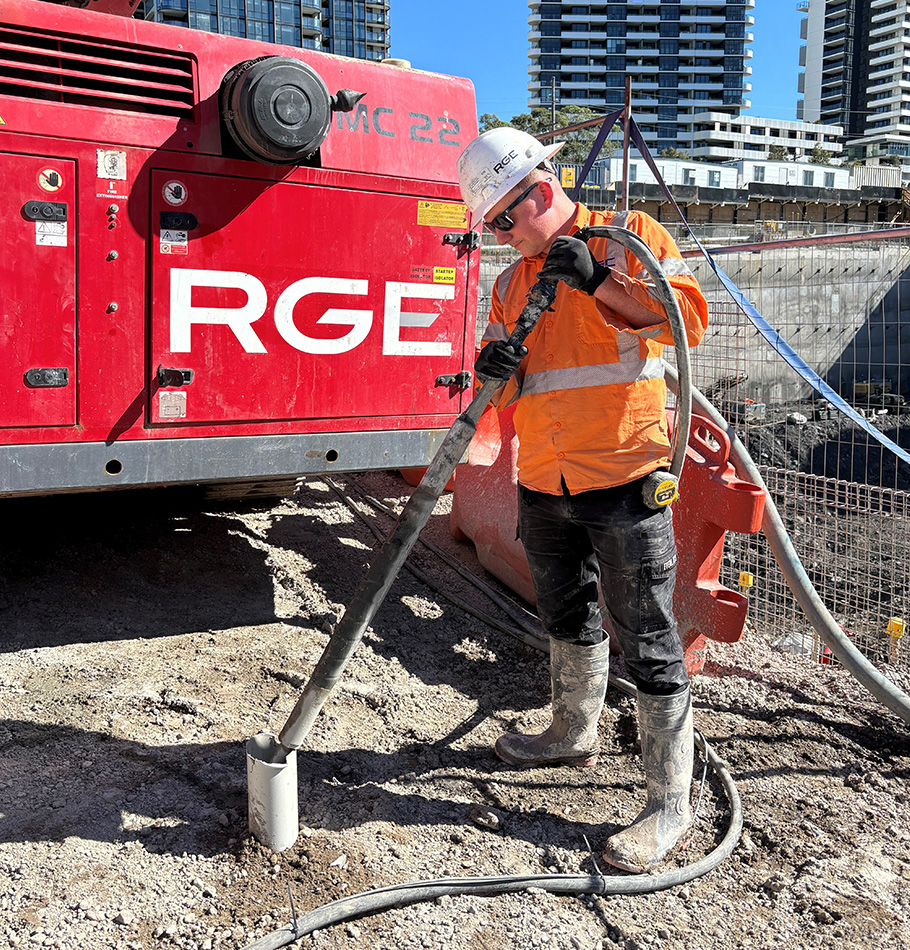
4. Controlled concrete pumping
5. Efficient column head cutting
The concrete column head is trimmed to the required elevation. Mechanical cutting is used for fresh concrete to speed up the process.
Next, hand-held breakers are applied if the concrete has hardened, ensuring clean, accurate cuts. This step prepares the column for load transfer platforms or structural slabs above.
6. Optional stone column integration
For projects requiring mixed-modulus columns, a stone column can be constructed above the rigid inclusion using a vibratory displacement method.
The rigid inclusion provides deep bearing support, while the stone column improves load distribution and drainage near the surface. This hybrid system further increases load-bearing capacity and settlement control where required.

FAQs
What are rigid inclusions, and how do they differ from piles?
Rigid inclusions are a cost-effective ground improvement method that uses high deformation modulus columns to reduce settlement and increase overall bearing capacity.
These unreinforced, grouted concrete columns are separate from the structure they support, and are generally installed when soil is too soft and/or loads are too high for aggregate piers.
Rigid inclusions are particularly effective in soft clays and for structures underlain by thick deposits of compressible soils, where settlement control and soil stabilisation are critical. The material used in rigid inclusions prevents bulging into weak soils to ensure stability and effectiveness.
While they may appear similar, the key difference between rigid inclusions and piles is that the design of rigid inclusions distributes the load between the column and the soil, whereas piles are engineered to support 100% of the load.
What applications are rigid inclusions used for?
Rigid inclusions play a key role in differential settlement mitigation, especially for projects near existing buildings or sensitive infrastructure, ensuring stability and safety by reducing the risk of uneven ground movement.
Common applications include the construction of:
- Road and rail embankments
- Low-rise buildings
- Civil infrastructure
- Industrial and commercial buildings
- Storage tanks and terminals
- Industrial flooring
- Warehouses
- Wind turbines
What is a load transfer platform, and why is it important?
An LTP is a crucial component in rigid inclusion ground improvement, acting as a layer of engineered granular fill. This engineered layer of granular or structural fill is installed above the rigid inclusions to distribute structural loads evenly across the columns and the intervening soil.
The LTP ensures proper load transfer, minimises differential settlement, and allows for the use of shallow spread footings even on sites with existing weak soils.
By bridging loads across the inclusions, the platform helps achieve the maximum allowable bearing capacity for the foundation system.
What materials are used in a rigid inclusion system?
The primary materials used to form rigid inclusions are unreinforced concrete, cement-treated aggregate, and grouted stone.
Unreinforced concrete is favoured for its high deformation modulus, which provides the stiffness needed to support heavy structural loads without inducing excess settlements.
Cement-treated aggregate and grouted stone are also utilised, particularly in controlled modulus columns and vibro concrete columns, where their composition helps prevent bulging of the element into soft clay or organic soil profiles.
These materials are specifically chosen to reinforce weak soils, ensuring the element’s capacity to transfer structural loads efficiently and maintain stability even in very soft clay or thick deposits of compressible soils.
What are the benefits of rigid inclusions?
Rigid inclusions are a highly effective ground improvement technique, with key benefits including:
- Economical foundations: Enables shallow spread footings on highly compressible soils. This is often more cost-effective than deep foundations, which require expensive pile caps and grade beams.
- Improved bearing capacity: Enhances load-bearing capacity in weak soils.
- Settlement reduction: Reduces overall settlements for a stable and predictable foundation.
- Minimal spoil: Generates very little spoil during installation, leading to a cleaner and more efficient construction site.
- Thinner platform: Lowers the risk of rigid inclusion head punching into the transfer platform, often allowing for a thinner, cost-effective platform design.
- Protected inclusions: Lowers the likelihood of costly damage to rigid inclusions from subsequent earthworks, ensuring integrity.
What quality control measures does RGE take?
RGE ensures the highest quality of rigid inclusion solutions through a comprehensive suite of quality control measures implemented before, during, and after installation. Our rigorous testing protocols are designed to verify the integrity and performance of every element.
Key quality control measures include:
- Field trials: These trials are conducted to verify column production parameters under actual site conditions.
- Digital recording & logging: We digitally record and log all execution parameters during installation, providing a detailed and precise record of the process.
- Comprehensive testing: A variety of tests are performed, such as:
- Column Diameter Verification: To ensure the correct dimensions of the columns.
- Column Material Compressive Strength Tests: To verify the strength of the column material.
- Column Integrity Tests: To assess the structural soundness of the columns.
- Column Load Tests: To confirm the load-bearing capacity of the installed columns.
The specific types and frequency of these tests are carefully determined based on the unique characteristics of each project, including its size and the prevailing geotechnical context.
Do you design and install these concrete columns across Australia?
Yes. RGE offers rigid inclusion design and installation services across Australia, with our team members in major cities such as Sydney, Melbourne, Brisbane, and Perth, as well as regional project locations.
For more information, enquire today.
How much do rigid inclusions cost?
The cost of rigid inclusions can vary significantly depending on several project-specific factors. These include the scale of the project, the geological conditions of the site, the required depth and diameter of the inclusions, and the overall complexity of the ground improvement solution.
To receive a precise cost estimate, enquire today.
Contact RIX Ground Engineering
Our excellent technical and operational knowledge allows us to tailor make solutions that give our clients the combination of cost, time and quality that best fits their requirements.




Improve ground conditions with RGE
RGE is part of The RIX Group, offering specialist geotechnical services across Australia and New Zealand. Our resources include over 50 major items of plant and 400 employees.
We are unique in the comprehensive range of services we provide, including ground engineering, ground improvement, shotcrete, retaining walls, piling, slope stabilisation, rope access asset maintenance, mining, tunnelling, demolition, and earthworks.